

Must-Read for Southeast Asian Aluminum Composite Panel Factories: 3 Common Quality Hazards and Process Avoidance Guide for PVDF Coating of Chinese Coated Aluminum Coils (2026)
With the booming infrastructure market in Southeast Asia, a large number of aluminum composite panel (ACP) production lines have been built in Indonesia, Vietnam, Thailand, and other places. In our long-term cooperation with Southeast Asian customers, we (HUABOND) have discovered a common misconception: Many ACP factories believe that as long as they purchase aluminum coils labeled "PVDF fluorocarbon coating," the final composite aluminum panels will definitely have a 20-year weather resistance lifespan.

However, in reality, from the purchase of coated aluminum coils from China to the final pressing into finished aluminum composite panels, key variables are involved, including the marine storage environment, uncoiling tension matching, and hot lamination temperature control. Once the process is out of control, even the best original coating from the Chinese manufacturer will be "secondarily damaged" and rendered unusable.
Today, based on after-sales visit data from nearly 50 ACP customers in Southeast Asia, the HUABOND technical team has reviewed three hidden pitfalls that most easily lead to coating failure. Regardless of which factory in China you source your coated aluminum coils from, mastering these experiences can help you save at least 3-5% on scrap material waste annually.
Pitfall 1: Coating Becomes Brittle and Crackles – Not Just an Adhesion Issue, But Also a Cause of Temperature Overshoot in Hot Press Lamination
Scenario Reenactment (Real Case from a Vietnamese Customer): A Vietnamese ACP factory received a batch of white PVDF aluminum coils. Upon uncoiling, the surface appeared flawless. However, after processing on the aluminum composite panel hot lamination production line (hot-press machine temperature approximately 180℃-200℃), fine cracks appeared in the coating at the bent edges (R-corners) of the finished panels. The customer's first reaction was, "The coating quality of Chinese aluminum coils is poor."
HUABOND On-Site Diagnosis and In-Depth Analysis: This is not due to poor coating quality, but rather the thermal history memory effect of the PVDF coating.
1. Original Factory Curing Completed: HUABOND's PVDF coating has already undergone peak metal temperature (PMT) curing at the original factory (240℃-250℃), forming a dense network of polymer chains.
2. Damage from Secondary High Temperatures: Although ACP thermal lamination only reaches 180℃, if the production line malfunctions and the aluminum coil remains inside the heating section for more than 2 minutes, the localized high temperature will induce the release of residual thermal stress within the coating, leading to micro-cracks.
3. Special Reminder: Southeast Asian factories often use second-hand equipment with severely aged temperature control probes. The actual temperature is often 10-15℃ higher than the displayed temperature, which is the main culprit for the white PVDF coating "baking yellow" or cracking.
HUABOND's Tips for ACP Factories to Avoid Pitfalls:
- Always Remove the Coil During Shutdowns: If the thermal lamination machine stops for more than 30 seconds, the aluminum coil in the lamination section must be immediately removed from the heat source. It is strictly forbidden to allow the aluminum sheet with the PVDF coating to be "baked" at high temperatures.
- Soften Tension Rather Tightly: At 180℃, the coating is at its softening critical point. If the unwinding tension is too high, the coating will be pressed together by the polymer film under tension, resulting in insufficient resilience after cooling, and cracking will inevitably occur during a 90-degree bend test. It is recommended to reduce the tension setting by 8%-10% compared to when using locally sourced, low-quality aluminum coils.

Pitfall 2: "Water Ripples" or Orange Peel Appearance After Lamination-A Hidden Disaster Caused by Moisture Absorption During Sea Freight Storage
Scenario Recreation (Real Case from a Philippine Customer): After receiving the container during the rainy season, the aluminum coil's outer packaging was dry. However, when the laminated product was viewed from the side against the light, the coating surface was covered with dense, slightly uneven surfaces (orange peel/water spots).
HUABOND On-Site Diagnosis and In-Depth Analysis: This is a "false dryness" phenomenon of the aluminum coil, rooted in the high humidity environment of Southeast Asia, causing the coating to absorb moisture and become sticky again.
1. The Coating's Hydrophilic Trap: PVDF primers typically contain acrylic resin to increase adhesion. During sea freight, the temperature difference between day and night causes condensation inside the container, and moisture slowly penetrates into the micropores of the coating surface.
2. ACP Lamination Outburst: When aluminum sheets containing moisture enter the lamination line and are heated, the moisture instantly vaporizes and expands. However, due to the polymer film and PE core layer covering the upper layer, the vapor has nowhere to escape, only pushing up the soft paint film to form bubbles or orange peel texture.
3. Differences between Domestic and Local Products: Local coating lines often have poor coating density and a moisture absorption rate 3-5 times higher than HUABOND standard products due to substandard curing temperatures or insufficient drying time.
HUABOND's Tips for ACP Factories to Avoid Pitfalls:
- Uncoiling and Adaptation Period: After the container arrives at the factory, it must be placed in a well-ventilated workshop without air conditioning for 24-48 hours to allow the aluminum coil temperature to match the ambient temperature and the moisture inside and outside the packaging to balance before being put into operation.
- Preheating roller dehumidification method (simple technical modification): If you need to rush to complete the project during the rainy season, it is recommended to install a row of infrared heating lamps at the inlet of the laminating machine to pre-dry the back of the aluminum sheet at 60℃-80℃. This method is extremely low in cost but can eliminate 90% of complaints about water ripples during the rainy season.

Pitfall 3: Coating Color Difference – Photochemical Pollution Caused by Protective Film Delamination
Scenario Recreation: 3-6 months after outdoor installation, customers complained of irregular, shiny patches on the aluminum composite panels, the shapes of which matched the seams of the protective film.
HUABOND On-site Diagnosis and In-depth Analysis: The culprit is the migration of pressure-sensitive adhesive from the protective film.
1. Chemical Reaction Under Exposure: Southeast Asia has extremely strong ultraviolet radiation. Small-molecule plasticizers and oligomers in inferior protective films (or wrapping films made from recycled materials) can seep back into the micropores of the PVDF coating under high-temperature exposure.
2. Irreversible Damage: This pollution cannot be washed off because it alters the gloss of the coating surface. HUABOND laboratory testing found that the 60-degree gloss value in the affected area dropped from the standard 30±5 to below 15, resembling scars when viewed from the side.
HUABOND's Tips for ACP Factories to Avoid Pitfalls:
- Double Anti-counterfeiting Procurement Standards: As an ACP factory, when purchasing coated aluminum coils, you should explicitly require suppliers to use "weather-resistant PE protective film." A qualified protective film, after baking at 80℃ for 24 hours, should not show an increase in peel strength exceeding 50% of its original value.
- The Ironclad Rule of Film Removal Time: It is recommended that the protective film be removed within 15 days of the finished aluminum composite panel being installed on the wall. If the film is not removed within one month, the risk of adhesive transfer will increase exponentially.
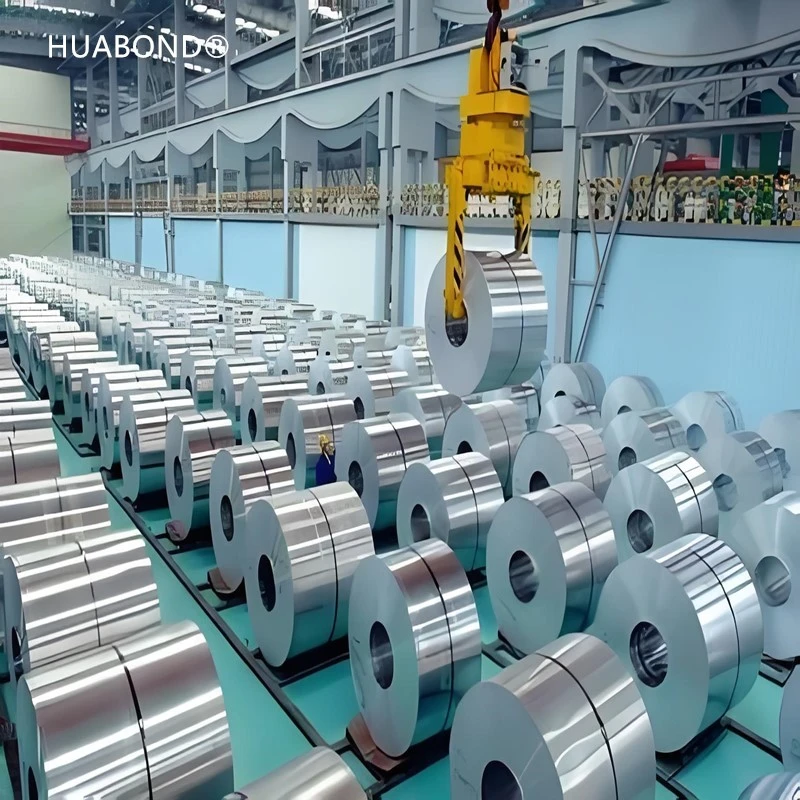
HUABOND's Perspective: Stable Coated Aluminum Coils are the "Balancing Stone" of ACP Factories
While some coating lines exist in Southeast Asia, insufficient pretreatment pickling tank volume and inadequate curing oven length (often less than 30 meters) result in numerous pinholes in the coating at the microscopic level. In the coastal salt spray environment, these pinholes corrode from the inside of the paint film within two years.
As a factory deeply rooted in the export of coated aluminum coils, HUABOND delivers not just a coil of aluminum, but a set of "thermal lamination window parameters" and a "weather resistance stability commitment."
If you encounter the following abnormalities in ACP lamination production:
- Severe powdering at the coating edges
- Blackening of the aluminum sheet after lamination
- Inadequate MEK wiping (below 100 cycles)

Please contact the HUABOND technical team directly to obtain customized coated aluminum coil material selection solutions for the climates of Southeast Asia and South America.
Tags: #CoatedAluminumCoils #PVDFCoating #AluminumCompositePanelProcessing #SoutheastAsiaBuildingMaterials #HUABONDExperience