

Advertising signage is exposed to the outdoors for extended periods, making stains, aging, and difficulty in cleaning a major maintenance challenge. This article systematically explains how to create a truly "easy-to-clean, low-maintenance" aluminum signage system, reducing total lifecycle costs, from aluminum composite panel selection, surface treatment, and structural design to installation methods.
Introduction: The "Aesthetic Maintenance Costs" of Signage Are Determined in the Design Phase
Whether in commercial complexes, office buildings, transportation hubs, or residential communities, aluminum composite panel advertising signage systems have become the mainstream choice for environmental wayfinding and brand display. However, many purchasers and designers only focus on the visual effect of the signage during installation, neglecting the cleaning and maintenance costs over the next 5 to 10 years.
You've surely seen signs like this: covered in dust, water stains, bird droppings, with black grime accumulating on the edges, and even peeling, faded, and difficult-to-clean coatings. This not only affects the image but also leads to frequent cleaning, repairs, and even complete replacement.
In fact, the ease of cleaning and maintenance of signage is 80% determined by the initial design. This article will provide practical design suggestions from the perspectives of both signage manufacturers and end-users, covering four dimensions: materials, coatings, structure, and installation.

I. Material Selection is Fundamental: Why Aluminum Composite Panels Have Advantages, But Choosing the Right Panel is Crucial
Aluminum composite panels (ACPs) are composed of two layers of aluminum sheets and a core material. Compared to pure aluminum sheets or iron signs, they have inherent advantages such as lighter weight, better flatness, and stronger weather resistance. However, not all aluminum composite panels are equally easy to maintain.
- Aluminum Sheet Thickness and Material:
For outdoor signage, the aluminum sheet thickness is recommended to be no less than 0.3mm (slightly less for indoor use). Too thin an aluminum sheet is prone to micro-deformation (the "oil drum effect") under heat or wind pressure, resulting in an uneven surface, water and dust accumulation, and increased cleaning difficulty. Prioritize virgin aluminum over recycled aluminum, as virgin aluminum has a dense surface with fewer pores, making it less susceptible to stain penetration.
- Core Material Weather Resistance:
Outdoor signage should use flame-retardant (FR) or high-density PE core materials to prevent the core material from absorbing water or expanding and contracting due to temperature changes, which could cause panel bulging and delamination. Once the panel warps or cracks at the edges, stains will hide in the gaps and are extremely difficult to clean.
Design Recommendation: Clearly specify in the signage project specifications that you should not choose non-standard panels to save a few tens of dollars-you'll regret it every time you clean it later.
II. Coating Determines "Can Stains Be Wiped Off?": Choose an Easy-to-Clean Surface Treatment
Whether a sign is easy to clean depends 90% on its surface coating. An excellent coating should possess the following characteristics: low surface energy (stains do not easily adhere), high hardness (resistant to scrubbing), and resistance to chemical corrosion (can be cleaned with detergents).
Currently, the mainstream aluminum composite panel coatings on the market fall into the following categories, with significant differences in ease of cleaning:
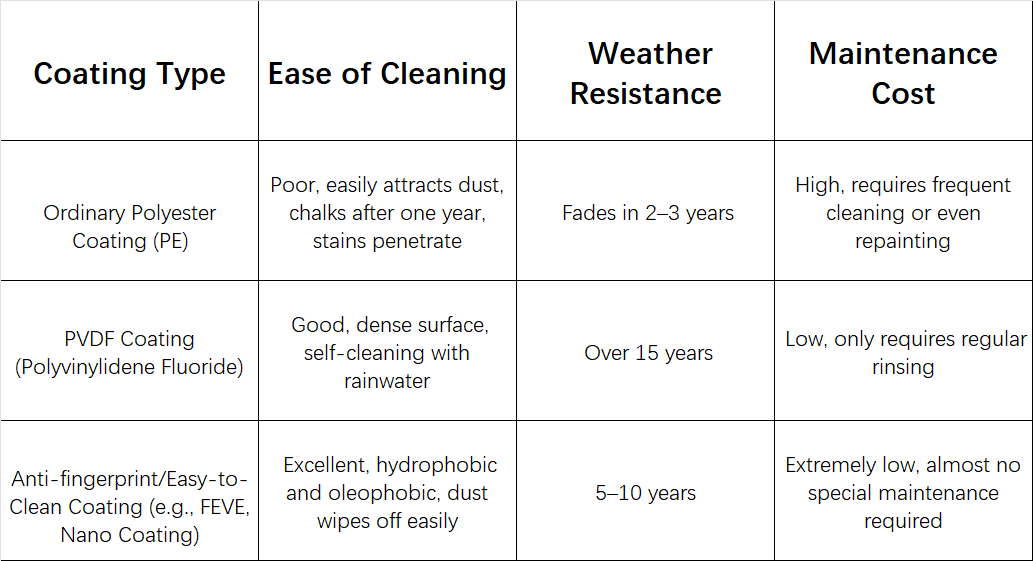
For outdoor signage, PVDF coating or an easy-to-clean topcoat is strongly recommended. PVDF itself has extremely low surface energy, making it difficult for dust and oil to adhere; ordinary rainwater can restore its cleanliness. If budget allows, choose an anti-fingerprint or self-cleaning coating. These coatings have a surface contact angle greater than 110°, allowing water droplets to wash away dirt.
Design Recommendation: Clearly specify in the technical specifications: "Coating type: PVDF, 70% fluorocarbon resin content, with a 10-year color retention guarantee." Also, request a stain resistance test: draw a line on the sample surface with an oil-based marker, wipe it with a dry cloth after 24 hours, and the easy-to-clean coating should be completely wiped away without residue.
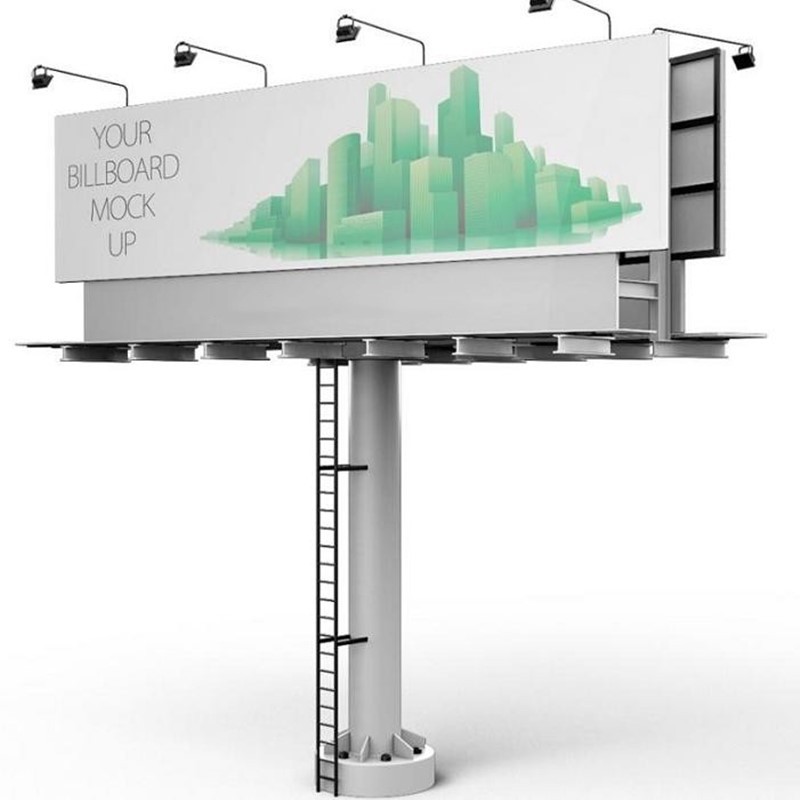
III. Structural Design: Making Stains "Nowhere to Hide" and Cleaning "Easy to Do"
Besides the materials themselves, the shape and assembly structure of the signage directly determine how much time cleaning is required.
3.1 Avoiding Dust Accumulation Dead Corners
- Right Angles vs. Rounded Corners: Right angles easily accumulate dust and are difficult to clean, while large rounded corners (R angle ≥ 5mm) allow a cloth or pressure washer to glide smoothly. All exposed corners should be designed as rounded as possible.
- Recesses and Gaps: If the signage has three-dimensional lettering or an inlaid structure, avoid blind grooves deeper than 10mm that cannot drain. Otherwise, rainwater mixed with dust will form stubborn stains, and may even mold and turn black. It is recommended that all recesses have drainage/sewage drainage holes (diameter ≥ 3mm) at the bottom.
- Surface Smoothness: Avoid complex textured surfaces unless specifically artistically required. Flat or slightly curved surfaces are easier to clean quickly with a pressure washer or sponge mop.
3.2 Removable/Replaceable Panel Design
The most difficult parts of large signage (such as rooftop lettering and entrance signs) to clean are the back and interior. The design should consider:
- Using slots and screws for panel fixing, rather than rivets or structural adhesive for permanent bonding. This allows the panel to be removed annually for cleaning the back and internal structure with a neutral detergent.
- Modular assembly: Large signage is broken down into several standard-sized panels, each independently detachable. When a part is damaged or severely contaminated, only the corresponding panel needs to be replaced, without disassembling the entire structure.
3.3 Edge Sealing Treatment
The cut edges of aluminum composite panels are prone to absorbing water or trapping dirt. The design should require the manufacturer to apply sealant or edge trim to the cut edges to prevent liquid from seeping into the core layer and causing bulging. Simultaneously, sealing the edges prevents stains from entering the interlayer, allowing cleaning only the surface to be treated.
IV. Installation Method: "Sturdy" and "Removable"
Many signs, once installed, become "permanent projects"-want to clean the back? Impossible. Want to replace the panel? Requires breaking through the wall.
Design Recommendations:
- For wall-mounted signs, use a concealed hook + screw mounting system instead of directly sticking them to the wall with structural adhesive. This allows the sign to be lifted and removed from the hook like a picture frame, facilitating a thorough cleaning once a year.
- For pillar-mounted signs, design quick-release connectors (such as stainless steel bolts + lock nuts) at the connection between the pillar and the panel, and leave sufficient operating space so that cleaning personnel do not have to crawl into narrow gaps.
Additionally, design drainage and ventilation holes on the back or side of the sign (covered with louvered insect screens) to prevent internal condensation from causing corrosion or mold growth.
V. Post-Production Cleaning and Maintenance Recommendations (Practical Operating Guide for Users)
Even the best design requires proper maintenance. You can include the following recommendations in the product manual to improve customer satisfaction:
- Daily Cleaning (Once a Month): Gently wipe with a soft cloth or sponge dampened with a neutral detergent (such as dish soap diluted with water, pH 6-8), then rinse thoroughly with water to avoid detergent residue. Do not use steel wool, hard-bristled brushes, or cleaning pastes containing abrasives.
- Heavy Stains (Bird Droppings, Oil Stains, Paint Marks): Spot clean with isopropyl alcohol (IPA, concentration ≤30%) or a dedicated PVC cleaner, then rinse immediately with water. Avoid using strong solvents such as acetone and toluene, as they will damage the coating.
- High-Pressure Water Gun Cleaning: Control the pressure at 5-8 MPa, keep the nozzle at least 30cm away from the surface at a 45° angle, and avoid spraying directly into edges and crevices.
- Prohibited actions: Cleaning in direct sunlight or at high temperatures (surface temperature > 50°C) will cause the cleaning agent to dry quickly, leaving water stains; do not use acidic or alkaline cleaning agents (such as oxalic acid, caustic soda).
VI. Life Cycle Cost Comparison: Easy-to-Clean Design Really Saves Money
Let's do a simple comparison and do the math. Assume an outdoor main signboard in a commercial plaza with an area of 20 square meters.
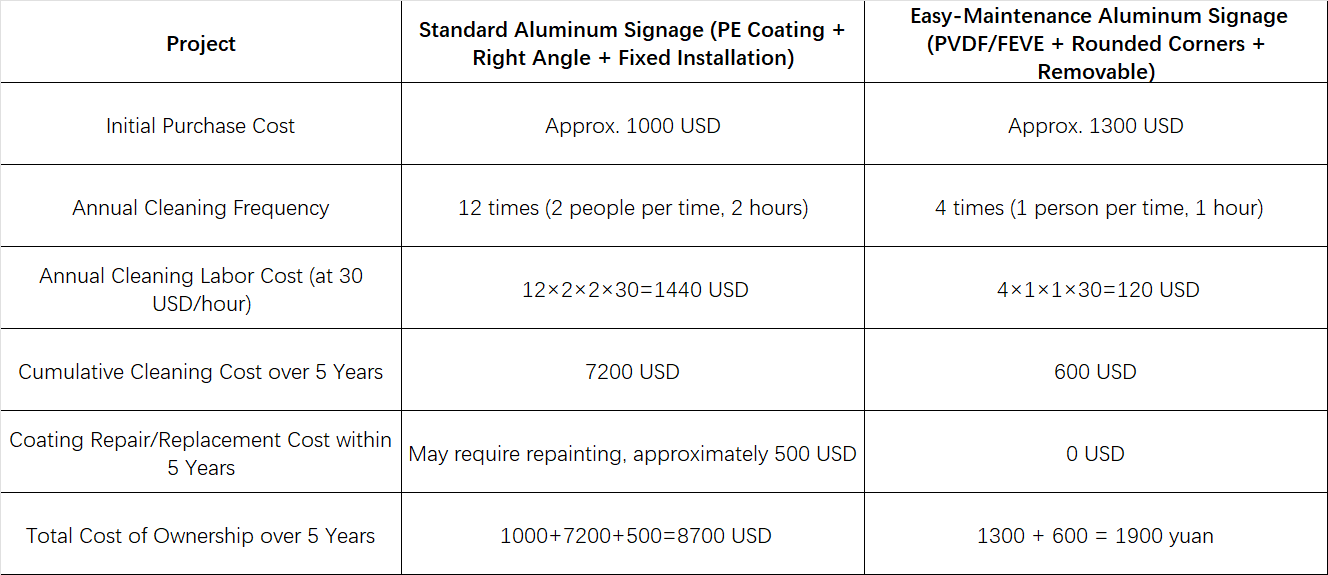
Conclusion: Although the initial investment for the easy-to-maintain design is 50% higher, the total cost over 5 years is only 29% of the ordinary solution. For signage with a service life of more than 10 years, the savings can reach tens of thousands of yuan.
Conclusion: Choosing a professional aluminum composite panel supplier solves maintenance problems from the design stage.
A truly excellent aluminum signage system isn't just about "looking good when installed," but about "looking good year after year without requiring major maintenance." This begins with the right material selection, scientific coating matching, user-friendly structural design, and maintainable installation methods.
As a professional provider of aluminum composite panels and signage solutions, we not only offer PVDF-coated aluminum composite panels that meet outdoor weathering standards, but also provide customized services such as edge sealing, modular disassembly structures, and easy-to-clean surface treatments based on your signage design. We can intervene in the design phase to help your project reduce cleaning and maintenance costs for the next 10 years.
Want to save your clients time and money? From the very first aluminum sign, include "easy to clean and easy to maintain" in the specifications.
Keywords: Aluminum signage system, easy-to-clean design, aluminum composite panel advertising signage, maintenance costs, outdoor signage, self-cleaning coating, aluminum signage, total life cycle cost, how to clean aluminum composite panel signage