



Definition of Aluminum Composite Panel
Aluminum composite panel is a composite material made of chemically treated coated aluminum plate as the surface material, polyethylene plastic or high mineral as the core material, and processed on special Aluminum composite panel production equipment.
There are many names of aluminum composite panels, some are called aluminum composite panels (Aluminum Composite Panels); some are called aluminum composite materials (Aluminum Composite Materials); there are also three layers, the structure looks like a cake sandwich, so it is also called aluminum Sandwich panel (Aluminum Sandwich panel), the world's first aluminum composite panel comes from a German factory, named ALUCOBOND. There are not many enterprises producing aluminum composite panels abroad, but the production scale is very large. Famous ones are Alusuisse Company headquartered in Switzerland, Reynolds Metal Company of the United States, (Alpolic)Mitsubishi Company of Japan, Daming of South Korea and so on. Auspicious of Taiwan, as well as China's famous enterprise Huabond and so on.
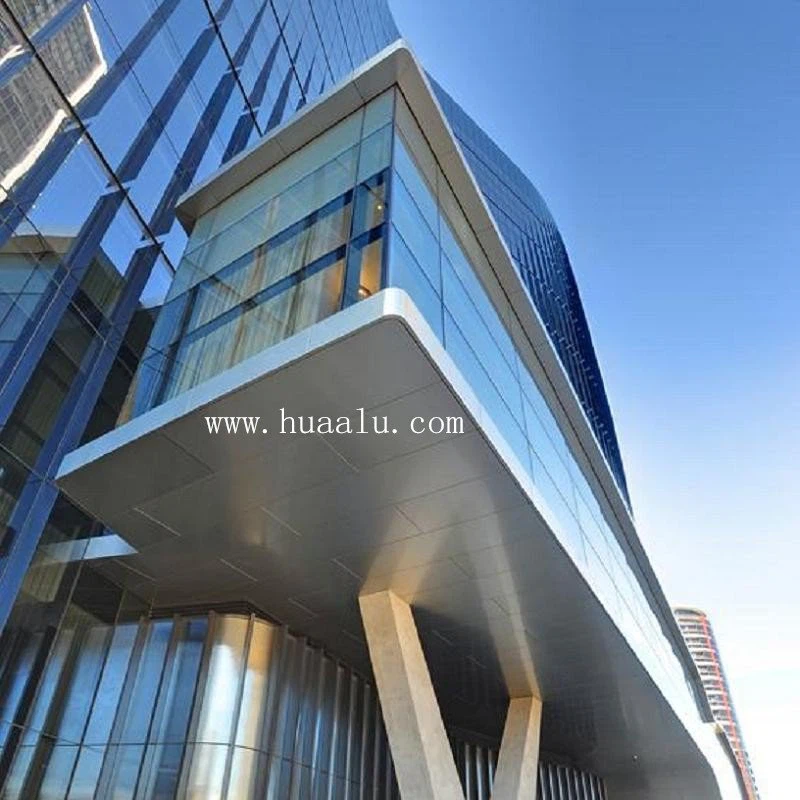
The unique properties of the aluminum composite panel itself determine its wide range of uses: it can be used for building exterior walls, curtain wall panels, renovation and renovation of old buildings, interior wall and ceiling decoration, advertising signs, display stands, purification and dustproof. project. It belongs to an economical, durable and cost-effective building decoration material and advertising material.
[Aluminum composite panel] is composed of two materials (metal and non-metal) with completely different properties. It not only retains the main characteristics of the original material (metal aluminum, non-metal polyethylene plastic), but also overcomes the shortcomings of the original material. , and obtained many excellent material properties. Such as luxury, bright and colorful decoration, weather resistance, corrosion resistance, impact resistance, fire resistance, moisture resistance, sound insulation, heat insulation, shock resistance; light weight, easy processing and molding, easy handling and installation. Therefore, it is widely used in various architectural decorations, such as ceilings, pillars, counters, furniture, telephone booths, elevators, storefronts, billboards, factory walls, etc., and has become one of the three major curtain walls (natural stone, glass curtain wall, metal Curtain wall) is the representative of metal curtain wall. In developed countries, Aluminum composite panels are also used in the manufacture of buses and train cars, as sound insulation materials for aircraft and ships, and in the design of instrument boxes.


Composition of Aluminum Composite Panel

Performance of Aluminum Composite Panel
Super peeling degree
The aluminum composite panel adopts a new process, which improves the most critical technical index of the aluminum-plastic composite panel-peel strength to an excellent state, so that the flatness and weather resistance of the aluminum composite panel are improved accordingly.
Material is easy to process
The weight of aluminum composite panel is only about 3.5-5.5 kg per square meter, so it can reduce the damage caused by earthquake disaster, and it is easy to handle. Various shapes such as sides, curved shapes and right angles can cooperate with designers to make various changes, and the installation is simple and fast, which reduces the construction cost.

Excellent fire performance
The middle of the aluminum composite panel is a flame retardant material PE plastic core material, and the two sides are extremely difficult to burn aluminum layers. Therefore, it is a safe fireproof material that meets the fire resistance requirements of building regulations.
Impact resistance
It has strong impact resistance, high toughness, no damage to the topcoat by bending, strong impact resistance, and no damage caused by wind and sand in areas with large sandstorms.
Super weather resistance
Due to the use of KYNAR-500-based PVDF fluorocarbon paint, it has unique advantages in weather resistance, no matter in the hot sun or in the cold wind and snow, it will not damage the beautiful appearance, and it can last for 20 years. fade.
Uniform coating and various colors
After chemical treatment and the application of Henkel's film technology, the adhesion between the paint and the aluminum composite panel is uniform, and the colors are various, allowing you to choose more space and show your individuality.
Easy to maintain
Aluminum composite panels have been significantly improved in terms of pollution resistance. my country's urban pollution is relatively serious, and it needs maintenance and cleaning after a few years of use. Because of its good self-cleaning properties, it only needs to use a neutral cleaning agent and water, and the panel will be permanently as new after cleaning.
Easy to process
Aluminum composite panel is a good material that is easy to process and form. It is also an excellent product for the pursuit of efficiency and time, which can shorten the construction period and reduce costs. Aluminum composite panels can be cut, cut, slotted, band sawed, drilled, countersunk, or cold-formed, cold-folded, cold-rolled, riveted, screwed, or glued.
1. Good weather resistance, high strength and easy maintenance.
2. The construction is convenient and the construction period is short.
3. Excellent processability, thermal insulation, sound insulation and excellent fire performance.
4. Good plasticity, impact resistance, can reduce the load of buildings, and good shock resistance.
5. Good flatness, light and firm.
6. There are many colors to choose from.
7. The processing equipment is simple and can be processed on site.
8. Patterns and patterns can be customized
Use of Aluminum Composite Panel
1. Building exterior walls and curtain wall panels.
2, interior wall decorative panels, ceilings.
3. Refit and refurbish the exterior wall of the old building.
4, air conditioners, TVs and other home appliances shell.
5. Panels, sign panels, display stands.
6. Balconies, equipment units, indoor compartments.
7, street signs, advertising sign panels.
8. Industrial materials, body of cold-insulating car.


Classification of Aluminum Composite Panel
There are many varieties of aluminum composite panels, and they are a new type of material. Therefore, there is no unified classification method. They are usually classified according to use, product function and surface decoration effect.
Sort by use

Aluminum composite panel for building curtain wall
The minimum thickness of the upper and lower aluminum plates shall not be less than 0.50mm, and the total thickness shall not be less than 4mm. The aluminum material should meet the requirements of GB/T 3880. Generally, 3000, 5000 series of aluminum alloy plates should be used, and the coating should be fluorocarbon resin coating.

Aluminum composite panels for exterior wall decoration and advertising
The upper and lower aluminum plates are made of rust-proof aluminum with a thickness of not less than 0.20mm, and the total thickness should not be less than 4mm. The coating generally adopts fluorocarbon coating or polyester coating.

Indoor aluminum composite panel
The upper and lower aluminum plates generally use aluminum plates with a thickness of 0.20mm, the minimum thickness is not less than 0.10mm, and the total thickness is generally 3mm. Coatings are polyester or acrylic.
Classification by product function
a. Fireproof panel
The flame-retardant core material is selected, and the combustion performance of the product reaches the flame-retardant grade (B1 grade) or non-combustible grade (A2 grade); at the same time, other performance indicators must also meet the technical requirements of the aluminum composite panel.
b. Antibacterial and mildew proof aluminum composite panel
The coating with antibacterial and bactericidal effects is coated on the aluminum composite panel, so that it has the function of controlling the reproduction of microbial activities and finally killing bacteria.
c. Antistatic aluminum composite panel
The antistatic aluminum composite panel is coated with antistatic paint, and the surface resistivity is below 109Ω, which is smaller than the surface resistivity of ordinary aluminum composite panels, so it is not easy to generate static electricity, and dust in the air is not easy to adhere to its surface.
Classified by surface decoration effect
a. Coated decorative aluminum composite panel
Various decorative coatings are applied to the surface of the aluminum sheet. Commonly used are fluorocarbon, polyester and acrylic coatings, mainly including metallic, plain, pearlescent, fluorescent and other colors, which have decorative effects and are the most common varieties in the market.

b. Brushed aluminum composite panel
The aluminum alloy panel with brushed surface is used, and the common ones are gold brushed and silver brushed products, which bring different visual enjoyment to people.c. Mirror aluminum composite panel
The surface of the aluminum alloy panel is polished like a mirror.

d. Color printing aluminum composite panel
Different patterns are printed on the transfer paper with various imitation natural patterns through advanced computer phototypesetting technology, and then various imitation natural patterns are indirectly reproduced on the aluminum-plastic panel through thermal transfer technology. It can meet the designer's creativity and the owner's personalized choice.
e. Film decorative composite panel
That is, according to the set process conditions, relying on the action of the adhesive, the color pattern film adhesive is attached to the aluminum plate coated with the primer or directly on the degreasing aluminum plate. The main varieties are gang grain, wood grain panel and so on.
Construction technology
Dry hanging aluminum composite panel construction technology
① The lay-out work is carried out according to the actual center line and elevation point of the civil construction; the design of the finish is based on the axis of the building. The Aluminum composite panel skeleton is composed of horizontal and vertical pieces. The anchor point of the vertical member is determined.
② Install the fixed connector on the basis of the pay-off, fix the connector by electric welding, and the anti-rust paint at the weld is twice. The connecting piece is welded and fixed with the embedded piece on the main structure. When there is no embedded iron piece embedded in the main structure, the main structure can be drilled to install expansion bolts to be fixed with the connecting piece of iron.
③ Install the skeleton. Install the skeleton by welding. Check the elevation and centerline position at any time during installation. At the same time, the cross-section connection welds are treated with anti-rust paint, and the fixed connectors are hidden. Inspection records include the length, thickness, and location of the connector welds. Set the elevation, quantity, and embedding depth.
④ Install the Aluminum composite panel on the inner frame of the profile, first tap and mill the screw holes, and use rivets to fix the Aluminum composite panel veneer on the steel frame piece by piece; the gap between the plates is 10-15mm, and then inject silicone Weather-resistant sealant; it is strictly forbidden to remove the wrapping paper before the installation of the aluminum plate, until the packaging protective film is torn off before the completion; construction shall be carried out according to the direction indicated by the arrow of the aluminum-plastic plate.
Quality analysis of Aluminum Composite Panel
Discoloration and discoloration of Aluminum composite panel
The discoloration and discoloration of aluminum composite panels are mainly caused by improper selection of panels. Aluminum composite panels are divided into indoor panels and outdoor panels. The surface coatings of the two panels are different, which determines their application in different occasions. The surface of the panel used indoors is generally sprayed with a resin coating. This coating cannot adapt to the harsh outdoor natural environment. If it is used outdoors, it will naturally accelerate its aging process and cause discoloration and discoloration. The surface coating of outdoor Aluminum composite panels is generally made of poly fluorocarbon resin coating with strong anti-aging and anti-ultraviolet ability, which is expensive. Some construction units deceive the owners, pretending to be anti-aging and anti-corrosion high-quality fluorocarbon sheets for indoor use, to squeeze unreasonable profits, thus causing serious discoloration and discoloration of the aluminum sheets used in the project.
Aluminum composite panel opening and falling off
The glue opening and falling off of the aluminum composite panel are mainly caused by the improper selection of the binder. As an ideal binder for outdoor aluminum composite panel projects, silicone adhesive has unique advantages. In the past, my country's silicone rubber mainly relied on imports, and its value was prohibitive for many people. Only those expensive curtain wall projects on high-rise buildings dared to care. Now, our country's Zhengzhou, Guangdong, Hangzhou and other places have successively put into production of different brands of silicone rubber, resulting in a sharp drop in prices. Now, when buying aluminum composite panels, the seller will recommend the kind of special quick-drying glue. This kind of glue can be used indoors, but when it is used outdoors where the climate is changing, the panel will open and fall off.
Deformation and bulging on the surface of aluminum composite panel
Walking around in any city, it is not difficult to find some unsightly projects where the surface of the aluminum composite panel is deformed and bulged. This phenomenon occurs in small facade decoration projects, as well as in large high-rise buildings. In the past, this kind of quality problem occurred in the construction, and we thought it was the quality reason of the plate itself; later, after everyone's concentrated analysis, we found that the main problem lies in the base plate of the aluminum composite plate, followed by the aluminum composite plate the quality of the panel itself. Dealers often provide us with the construction technology of aluminum composite panels, and the recommended base materials are mainly high-density panels, woodworking panels and the like. In fact, when this type of material is used outdoors, its service life is very fragile, and it will inevitably deform after being blown by wind, sun, and rain. Since the base material is deformed, how can the aluminum composite panel as the surface layer not be deformed? It can be seen that the ideal outdoor base material should be treated with anti-rust treatment to form a skeleton with angle steel and square steel pipe. If conditions permit, it is more ideal to use aluminum profiles as the skeleton. The cost of the skeleton made of this kind of metal material is not much higher than that of wooden keel and high-density panel, which can indeed ensure the quality of the project.

Aluminum composite panel glue seam is neat
When the aluminum composite panel is used to decorate the surface of the building, there are generally gaps of a certain width between the plates. For the sake of beauty, black sealant is generally filled in the gap. In order to save time when gluing, some construction workers do not use paper tape to ensure the neatness and rules of gluing, but use the protective film on the surface of the aluminum composite panel as a substitute. When the aluminum composite panel is cut, the protective film will be torn to varying degrees, so using it as a substitute for protective tape, it is impossible to tidy up the glue seam.
Common quality problems and their solutions in the composite process of aluminum composite panels
There are two main quality problems in aluminum composite panels, one is the coating quality; the other is the composite quality. Coating quality problems appear in the process of aluminum plate pretreatment and coating and baking paint processing, while composite quality problems are mainly technical problems and management problems in the composite process. Some of these problems are affected by a single factor, and some are affected by multiple factors. The quality problems in the composite process of aluminum composite panels mainly include bubbling on the panel surface, sunken spots on the panel surface, lotus leaf edges and poor bonding, which will be analyzed and discussed separately below.
Bubbling on the panel
The bubbling on the surface of the aluminum composite panel is that when the core panel is extruded, there are granular infusible materials. When the average diameter of these infusible materials is large to a certain extent, it will protrude from the surface of the core panel, and the composite will cause the panel surface bubbling phenomenon. When we peel off the aluminum plate, we will find that there are signs of poor adhesion around the bubbles. The reason for this sign is that when the bubbles are being rolled and compounded, the air around the bubbles cannot be completely squeezed out and clamped. In the middle of the layers, an extremely thin air layer prevents the layers from being fully bonded. These infusible may be other impurities mixed in the plastic particles, or other plastic particles. The melting point of these plastics is much higher than that of polyethylene, which cannot be melted in the screw barrel and is blocked on the side of the stainless steel wire mesh. , When the aggregation reaches a certain level, the extrusion back pressure will increase, so that the filter screen will be broken and the core panel will be extruded together to cause bubbling of the core panel. If the particle size of the infusible material is too large, it may be stuck in the die, forming a deep imprint on the surface of the extruded core panel, which will also cause quality problems on the panel surface.
For the production of thin plastic sheets, it is necessary to use multiple layers of a certain number of stainless steel wire meshes for filtration. For aluminum-plastic core panels, an orifice plate with a certain aperture that is much smaller than the thickness of the plate can be used to filter without causing breakage. Generally, it can be solve the bubbling problem.
Sunken spot
There is a thumbprint-sized collapse on the surface of the aluminum composite panel, which is caused by the stiffness of the polymer film. The stiffness of the polymer film varies in size, generally the size of a rice grain, and it is white, which is a quality problem of the adhesive layer. When these protruding granules are compounded, the air around them cannot be completely extruded like the above-mentioned bubbling phenomenon, and is wrapped into the board. The doubling of places are directly affected, forming pits. It is necessary to eliminate the quality problems of this material from material procurement and production management.
Ruffles
The ruffle is the wave on the edge of the board. This is a common problem, mainly caused by wavy edges of aluminum coils. The wave of aluminum coil is a rolling quality problem, and the serious wave deformation cannot be completely solved even after the drawing, bending and correction of the post-finishing process. In addition, the aluminum coil heats up too fast in the baking paint. If the plate temperature rises to a very high temperature immediately after entering the oven, the aluminum plate will expand rapidly. This will form a great contrast with the unheated aluminum plate in the boundary area, which will inevitably lead to the surface of the plate thermal deformation, resulting in ruffles.
It is difficult to require the aluminum coil to be absolutely flat, and it can be used without affecting the flatness of the aluminum composite panel within the technical requirements. In production practice, sometimes the aluminum coil does not seem to have obvious ruffles, but the ruffles are produced during the lamination process. The lotus leaf on one side of the aluminum coil is a serious deformation. For very serious deformation, although the lotus leaf is not caused, it will form a side relaxation phenomenon. The tension control braking device of the unwinder on the composite production line is generally installed on one side of the unwinder. Since the rigidity of the core of the aluminum coil is not very large, even if the coil is flat on both sides, it will be unrolled on the other side. There is also a slight slack in the aluminum plate. If the aluminum coil with a little slack is installed on the side without braking, it may cause a lotus leaf, otherwise it will not cause a lotus leaf. To solve this accidental phenomenon, it is an effective method to install braking devices on both sides of the unwinder to control it.
In a word, the formation of the lotus leaf is mainly a problem of the aluminum coil, and the severely deformed aluminum coil can only be scrapped, but the less serious deformation can be eliminated by increasing the tension. There are two tractors on some composite lines. In this case, special attention should be paid to the speed ratio relationship between the two tractors, that is, if the tension of this section of the board is adjusted well, it will also cause ruffles if it is too small.
Poor bonding
Poor bonding or even degumming is a very worrying problem in the production of aluminum composite panels. There are many factors that cause this problem, including equipment and operations. The cold shrinkage deformation of the core plate and the deformation of the aluminum coil, as well as the pollution of the aluminum surface by the smoke in the baking paint, will cause poor adhesion. When the plastic contains low-molecular-weight chemical additives such as opening agents and slip agents, the adhesive force of the adhesive layer will also be slowly destroyed, resulting in degumming. Therefore, for the phenomenon of poor bonding, we need to analyze specific problems and find out the crux to solve them.
Concluding remarks
Through the analysis of some common quality problems encountered in the processing and assembly of aluminum composite panels (composite aluminum panels), the measures and methods to solve them are put forward, which will surely enable the construction personnel to process and install aluminum composite panels. Common quality problems can be prevented and controlled. Aluminum composite panel is a composite material made of chemically treated coated aluminum plate as surface material, polyethylene plastic as core material, and processed on special aluminum composite panel production equipment. Aluminum-plastic composite panels have been widely used around the world and belong to a new type of building decoration material.
Since its entry into my country in the late 1980s and early 1990s, the aluminum composite panel curtain wall has been widely used and developed rapidly in my country's building curtain wall industry, contributing to the diversification of my country's building curtain wall products and architectural styles. . However, as a product, the aluminum composite panel curtain wall is still not perfect in technical specifications in my country and under the squeeze of some unfair market competition, resulting in the confusion of the aluminum composite panel product market, the decline in quality, and the processing of aluminum composite panel curtain wall. There are many quality problems in the installation and many unsafe factors are lurking. At present, it is experiencing a dangerous process of descending from high-grade products to low-grade products. In the process of re-compiling the national product standard of "Building Curtain Wall" this time, we have conducted some preliminary investigations on the current situation of my country's aluminum composite panel industry and aluminum composite panel curtain wall industry, and believe that it is necessary to discuss the current situation and future of aluminum composite panel curtain wall The development of aluminum composite panel is discussed in order to attract the attention of the industry, correct some incorrect practices in time, eliminate people's doubts, and let the aluminum composite panel industry and aluminum composite panel curtain wall get on the right track as soon as possible.
