

Introduction: Temperature, the Invisible Challenge of Building Facades
Across the globe, from the scorching deserts of the Middle East to the bitterly cold winters of Northern Europe, building facades are constantly subjected to drastic temperature fluctuations. This thermal expansion and contraction is the primary cause of warping, deformation, cracking, and even peeling in traditional curtain wall materials (such as ordinary metal panels, glass, and stone). For modern buildings striving for ultimate flatness and long-term durability, effectively managing thermal stress is a core challenge facing designers and contractors.
Aluminum Honeycomb Panels, a representative of high-performance building composites, are widely acclaimed for their exceptional resistance to thermal deformation. The key to this is their sophisticated structural design and the scientific application of the coefficient of thermal expansion (CTE). This article will provide an in-depth analysis of the workings of this "invisible guardian," revealing why aluminum honeycomb panels are a reliable choice for weathering extreme climates around the world.
Part 1: Understanding the Coefficient of Thermal Expansion-The "Breathing" Property of Materials
* What is the Coefficient of Thermal Expansion (CTE)?
The coefficient of thermal expansion is a physical quantity that measures the degree to which a material's dimensions change with temperature. The unit is typically µm/m·°C (micrometers/meter·degrees Celsius). Simply put, it indicates how many microns a material will expand per meter of length for every 1°C increase in temperature.
* CTE of Aluminum: Pure aluminum has a CTE of approximately 23.6 µm/m·°C. This means that for every 10°C increase in temperature, a 1-meter-long aluminum sheet will increase in length by approximately 236 microns (0.236 mm). For a building curtain wall spanning dozens of meters, the cumulative expansion and contraction can reach several centimeters. If not properly addressed, the consequences can be disastrous.

Part 2: The "Stability" Secret of Aluminum Honeycomb Panels - A Triumph of Structural Mechanics
Aluminum honeycomb panels do not simply lower the CTE of aluminum. Instead, through their unique sandwich structure and mounting system design, they minimize the effects of thermal expansion and contraction, effectively preventing deformation. The core principles are as follows:
1. "I-Beam" Effect and High Rigidity:
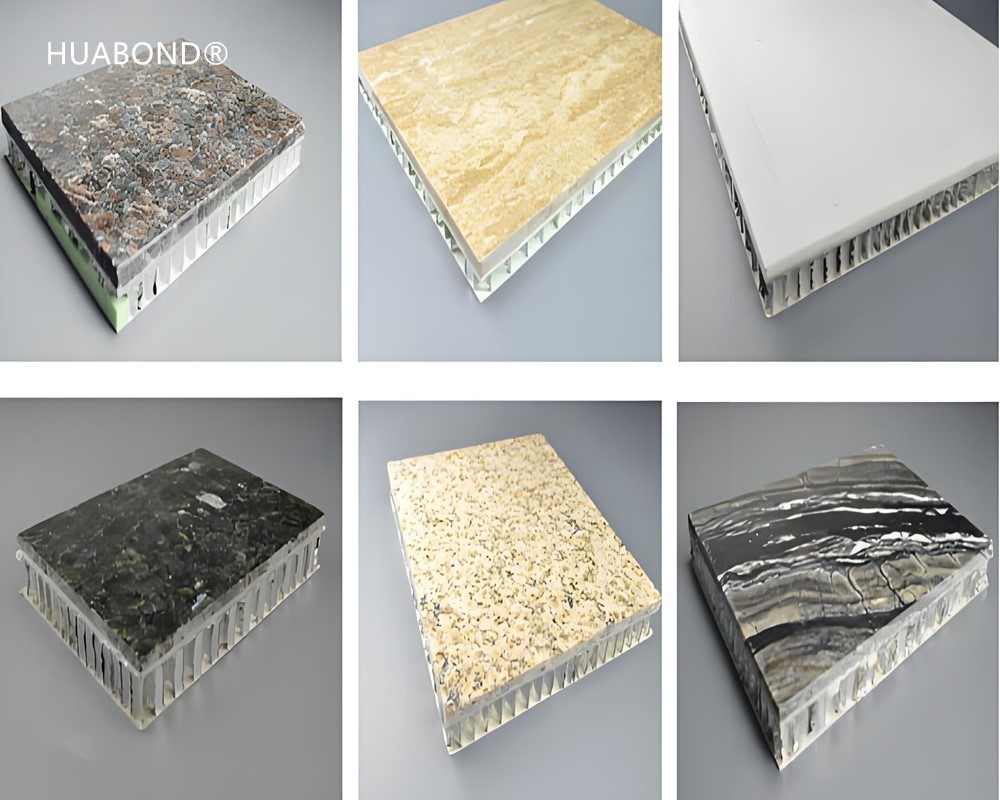
* Aluminum honeycomb panels are composed of two thin aluminum face sheets and a honeycomb aluminum core in between, bonded together with a high-strength adhesive, forming a classic "sandwich" structure.
* This structure is mechanically equivalent to a giant "I-beam." The face sheets bear tensile and compressive stresses, while the honeycomb core acts as a "web," primarily bearing shear forces. It also firmly connects the two face sheets, significantly improving overall bending stiffness.
* Key Point: High stiffness means the panel has an extremely strong resistance to bending deformation. Even if internal stresses are generated by temperature fluctuations, this rigid structure effectively prevents visible "arching" or "sag" in the panel.
2. Stress Dispersion and "Zero Expansion" Design:
* The honeycomb core is composed of countless hexagonal cells, which can undergo minute, controlled deformation when subjected to stress.
* When temperature fluctuations cause the panel to expand or contract, this stress is transferred to the honeycomb core through the adhesive layer. The honeycomb core's microstructure absorbs and distributes some of the thermal stress, preventing stress concentration at the panel edges.
* More importantly, the high-quality two-component polyurethane adhesive (2K PU Adhesive) exhibits excellent elasticity and toughness, which can cushion minor displacements between the panel and core, further protecting the bond from damage.
3. Revolutionary Installation System-Allowing for "Free Breathing":
* This is the ultimate safeguard against deformation. We never recommend gluing aluminum honeycomb panels to the wall like tiles.
* Using a T-Clip or sliding installation system, the panels are fixed to the frame using sliding clips. A gap is designed between the clips and the frame. * Working Principle: When the temperature rises and the panel needs to "elongate," it slides freely along the keel in the designed direction. When the temperature drops and the panel needs to "contract," it also contracts accordingly. Throughout this process, the panel itself remains straight, and deformation is converted into tiny displacements on the keel.
* Result: The panel surface remains consistently flat, and the width of the panel seams varies evenly, perfectly solving the problem of thermal expansion and contraction.

Part 3: Practical Application Advantages - Why International Projects Trust Aluminum Honeycomb Panels?
1. Extra-Large Size, Extremely Flat: Thanks to its high rigidity and scientific installation, aluminum honeycomb panels can be constructed in sizes up to 6 meters or longer. They maintain exceptional flatness across a wide temperature range of -40°C to +80°C, satisfying the minimalist, seamless aesthetics sought after by modern architecture.
2. Superior Durability and Safety: They effectively prevent structural fatigue, adhesive degradation, panel cracking, or peeling caused by thermal stress accumulation, significantly extending the service life of curtain walls and improving building safety. They are particularly suitable for high-rise buildings and public facilities.
3. Adaptability to Global Climates: Whether in the scorching sun of Dubai or the icy snows of Siberia, aluminum honeycomb panel systems can withstand the elements with stability, making them a truly "global" building material.
4. Reduced Maintenance Costs: Stable performance means less repairs and replacements, saving customers long-term maintenance costs.

Part 4: Professional Advice - Maximizing Thermal Stability
* Choose high-quality products: Ensure honeycomb panels are made of a suitable aluminum alloy, such as 3003H24 or 5052AH14. Use a two-component polyurethane adhesive, cured in an autoclave or laminating table, to ensure bond strength and durability.
* Design appropriate panel gaps: Before installation, accurately calculate thermal expansion and contraction based on the maximum local temperature difference and design adequate panel gap widths (typically ≥ 8mm).
* Strictly adhere to installation regulations: Use a mounting system that allows for sliding, and ensure the keel system is flat and secure. Never use rigid fixings!
* Choose high-quality sealant: Use a highly elastic, neutral, weather-resistant silicone sealant, whose inherent expansion and contraction properties can help absorb some movement.

Conclusion: Protecting the Beauty of Architecture with Science
The "magic" of aluminum honeycomb panels, which counteract thermal expansion and contraction, stems not from changes in the CTE of the material itself, but from the perfect combination of sophisticated structural design and a smart installation philosophy. It integrates materials science, mechanical principles, and engineering practices to provide architects and engineers worldwide with a stable, reliable, and aesthetically pleasing solution.
Choosing our aluminum honeycomb panels means you're not just acquiring a material; you're acquiring a proven architectural stability system that withstands the test of time and weather. Whether it's a landmark building or a commercial complex, we can provide you with professional technical support and customized solutions.

