

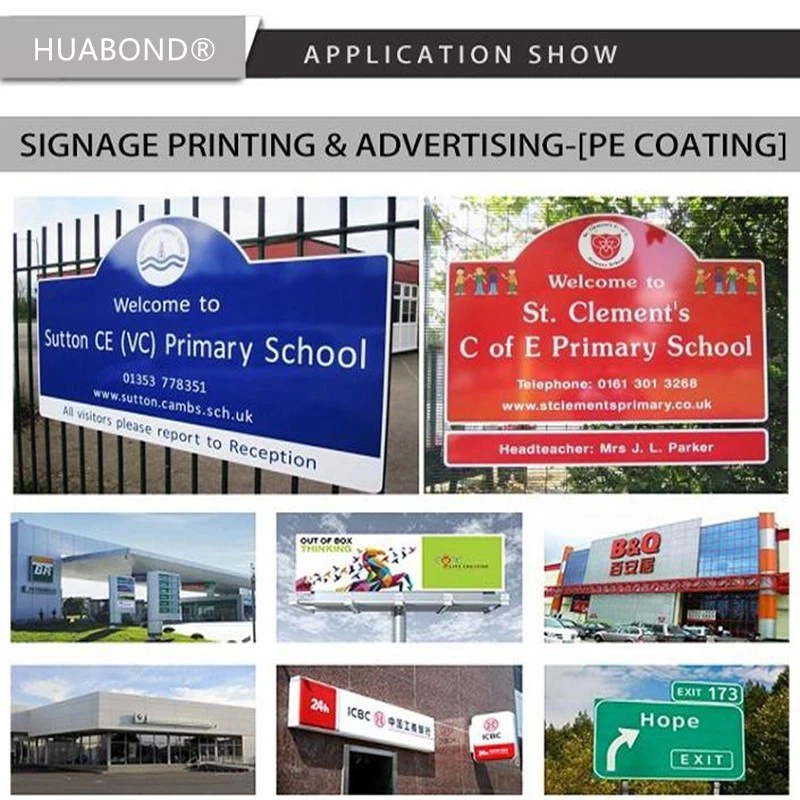
Applicable Scenarios: Commercial Signage, Parking Lot Guidance, Construction Site Safety Notices, Shopping Mall Wayfinding Systems
Target Market: North America (United States, Canada)
I. Why is the North American Market Increasingly Favoring Modular Aluminum Signage Panels?
In the United States and Canada, whether in commercial complexes, schools, hospitals, municipal projects, or construction sites, signage systems face two major pain points:
1. Tight Installation Cycles: Project delays can result in penalties of hundreds of dollars per day.
2. High Maintenance Costs: Traditional single-panel signage requires complete replacement if damaged, incurring high labor costs. The emergence of modular aluminum signage panels aims to solve both of these problems simultaneously.
II. What are Modular Aluminum Signage Panels?
Simply put, a large aluminum signage panel is broken down into multiple independently detachable, reconfigurable, and replaceable standard units, much like Lego bricks.
Typical Structure:
- Outer Frame (aluminum alloy profile, uniform specifications)
- Panel Unit (aluminum plate, surface coated or UV printed)
- Connectors (clasps/screws/magnetic attachments)
- Back Panel (rust-proof treatment)
Each unit is typically within 24 inches x 24 inches in length and width, facilitating single-person handling and assembly/disassembly.

III. How does modular design achieve "rapid installation"?
1. Prefabricated production, no on-site cutting required:
Traditional aluminum panels require on-site measurement, cutting, and drilling, taking 2-4 hours.
Modular signage panels are all cut, laminated, and drilled in the factory. On-site installation simply involves embedding them into the outer frame in sequence and tightening them. A large sign can be completed in 15-30 minutes.
2. Lightweight structure, operable by one person:
A single module weighs only 3-5kg (approximately 6-11 lbs), eliminating the need for a lift or two workers for transport.
Given the high labor costs in North America ($50-100/hour/person), saving half the labor time directly translates to reduced project costs.
3. Standardized installation accessories: Utilizing 1/4-inch stainless steel clips and pre-drilled mounting holes common in the North American market, compatible with common posts, wall mounts, and T-shaped bases, eliminating the need for custom adapters. Installers can start using them immediately.
IV. Why is Post-Maintenance Easier?
1. Individual Module Replacement
Traditional whole-panel signage: Scratched, faded, or impact-deformed → Complete removal and re-installation → Cost $200-500 + 2 weeks. Modular signage → Only the damaged section needs to be removed → Cost $20-50 + 3 days for new module delivery → On-site replacement in 5 minutes.
2. No Need for Complete Frame Disassembly
The frame is fixed to the wall or column and cannot be moved. When changing content, simply remove the old panel unit and insert the new one.
Especially suitable for: changes in parking lot prices, store replacements in shopping malls, and updates to construction site safety regulations.
3. Surface Renovation, Extended Lifespan
The aluminum panel module surface can be coated with a removable outdoor-grade film or UV inkjet coating. Maintenance only requires re-coating or localized touch-ups, saving 80% of the cost compared to a complete re-installation.

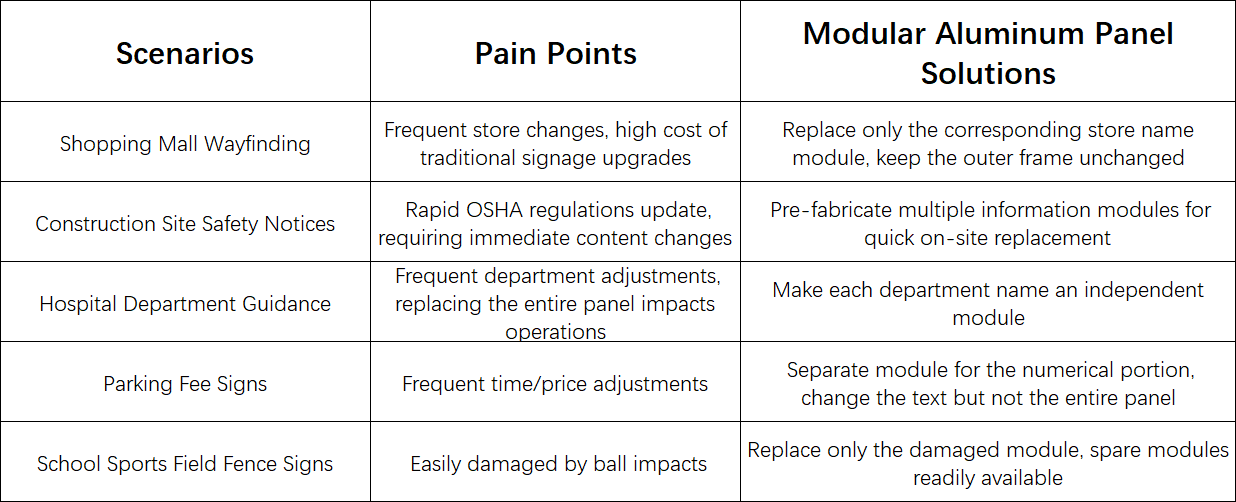
V. Typical Application Scenarios (North American Examples)
VI. Frequently Asked Questions (FAQ)
Q: Will the gaps between modules be noticeable?
A: Each module has a 1-2mm tolerance gap, which is almost invisible from a distance and facilitates rainwater drainage, preventing water accumulation and corrosion.
Q: Can it support double-sided displays?
A: Yes. Double-sided aluminum composite panels or double-layer back-to-back modules are used, with the thickness controlled within 25mm.
Q: How is its wind resistance?
A: The modular design actually increases wind load distribution. The small area of each module prevents it from tearing even under high-speed winds.
Q: Is it suitable for the extremely cold environments of Canada or the humid and hot environments of Florida?
A: Aluminum itself is corrosion-resistant, and with an outdoor-grade powder coating (resistant to salt spray for over 500 hours), the operating temperature is -40°C to 80°C, making it suitable for use throughout the US and Canada.
VII. Conclusion
For contractors, property managers, and municipal procurement personnel in the North American market, time is money, and maintenance is a major pain point.
Modular aluminum signage panels are not simply about cutting a large panel into pieces; they fundamentally change the logic of signage production, installation, and maintenance.
If you are looking for an aluminum signage solution suitable for the North American market that can be quickly implemented and is easy to maintain, modular design is the most practical answer.