

Author: HUABOND Coated Aluminum Coil Technology R&D Department
In the process of receiving inquiries for aluminum exports, we often encounter classic questions from customers: "I need aluminum sheets of this color, why are you recommending coils? I'll have to go back and level them myself, won't that increase costs?" Or more directly: "Can't ordinary aluminum sheets with a protective film work just as well? Why choose coated aluminum coils?"
With 25 years of experience in the industry, we have served project sites in over 40 countries and regions worldwide. Repeated experience has proven that coated aluminum coils, seemingly requiring an "extra step," are actually the optimal solution for industrial aesthetics and cost-effectiveness. Today, we won't discuss abstract theories; we'll delve into the underlying logic from the ground up in factory workshops and construction sites.

I. The Gap in Technological Processes: Roll Coating vs. Spray Coating
If you take a piece of ordinary aluminum sheet for post-processing (usually sheet spray coating), the process is: aluminum sheet leveling and shearing → manual or automatic spray coating → high-temperature baking. This is an "intermittent" process.
However, coated aluminum coils use a continuous roll coating process. The aluminum coil, in its uncut state, passes through a washing, passivation, coating, and baking production line at a speed of tens of meters per minute.
Here's a "secret of experience" known only to veteran craftsmen: On a continuous roll coating line, because the substrate passes through at a uniform speed in roll form, the leveling effect of the paint film in its liquid state is extremely smooth. However, in sheet spray coating, due to edge effects and pauses, edge shrinkage or paint accumulation in the middle often occurs.
Result Comparison:
- Coated Aluminum Coils: Film thickness tolerance controlled within ±1-2μm, mirror-like color, no color difference from beginning to end.
- Post-processed ordinary aluminum sheets: Film thickness tolerance is typically only ±5-8μm, and uneven coloring is easily observed between different batches.
E-E-A-T Interpretation: We once supplied two sample solutions for a curtain wall project of a five-star hotel in Dubai. When sunlight shines at a 45-degree angle, the orange peel texture of the sheet-coated panel is clearly visible, while the roll-coated aluminum coil exhibits a perfect metallic luster. At that moment, the client immediately decided: "Only use coil material."
II. The Powerful Physical Performance: The Secret to Cracking-Free Deep Drawing
Many customers believe that ordinary aluminum sheets, after being coated, will have better paint adhesion. The opposite is true.
The core advantage of coated aluminum coils lies in "0-T bending." Because the coating is completed in the aluminum coil state and then cured, the paint film and aluminum atoms form a synchronized physical memory. When subsequent complex bending, stamping, and grooving processes are performed, the paint film extends along with the aluminum sheet.
Our laboratory has conducted extreme tests:
- A roll-coated aluminum coil (PE coating) was folded 180 degrees. Observing the bend under 30x magnification, the paint surface showed no cracks or delamination.
- Under the same conditions, when sheet-coated aluminum sheets were folded, visible radial micro-cracks appeared at the bend.
What does this mean for your business? If you are producing decorative curtain wall honeycomb panels, awning edging, or ceiling panels, using ordinary aluminum sheets for coating means that every bend is a gamble. Even with complex R-angle bending, coated aluminum coils offer a significant advantage in yield.
III. Redefining Cost-Effectiveness: Hidden Costs Are the Main Issue
This is the most perplexing point for foreign trade buyers. Let's calculate the total cost across the entire supply chain:
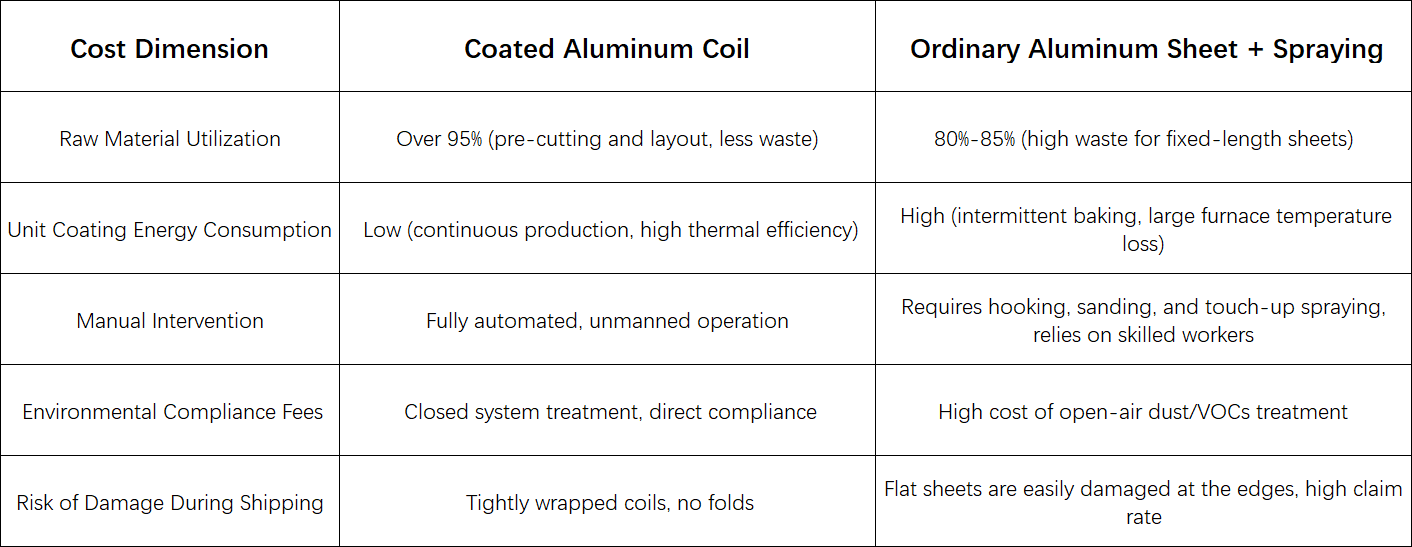
E-E-A-T Experience: Last year, a South American customer, in order to meet a tight deadline, insisted on using ordinary aluminum sheets from his inventory to have them coated at a local small factory. However, due to inadequate dust removal at the local coating line, the sheets were covered in particles, resulting in a pockmarked appearance from a distance after installation. Ultimately, the entire sheet had to be removed and reworked. The lost time and rework costs were enough to buy twice the amount of high-quality roll-coated aluminum coils.

IV. The Invisible Moat of Sustainability and Foreign Trade Compliance
In 2026, the EU's carbon tariff (CBAM) and environmental directives are becoming increasingly stringent. Large contractors will focus on reviewing suppliers' Environmental Product Declarations (EPDs) during procurement.
Coated aluminum coils are inherently "green" products:
1. Closed-loop system: Roll coating lines use solvent recovery incineration (RTO) systems, converting waste gas into heat energy for reuse, truly achieving low emissions.
2. Chromium substitution: Leading coated aluminum coil manufacturers have long adopted chromium-free passivation technology, complying with RoHS and REACH standards. Meanwhile, scattered post-coating workshops often still use pretreatment agents containing heavy metals.
3. Lightweight transportation: The compactness of coil form is far greater than that of loose sheets, increasing container load by approximately 15% for the same amount of cargo, directly reducing your product's carbon footprint at sea.
V. Practical Suggestions: Upgrading Your Understanding from "Selling Sheets" to "Selling Solutions"
If your customers are still wondering "Why buy coils?", please send them the following image-this is not just a product, but a solution:
Scenario A (Using Ordinary Aluminum Sheets):
Purchase raw sheets → Inspection for scratches at the factory → Shearing → Spray coating (punctures) → Curing (color difference) → Unpacking and packaging (scratches) → On-site installation (touch-up paint found) → Powdering and paint peeling after 3 years.
Scenario B (Using Coated Aluminum Coils):
Purchase coated coils → Leveling/slitting (no scratches) → Stamping/bending (perfect adhesion) → Direct installation → 15-20 year warranty.
Our persistence stems from "experience."
Ten years ago, a batch of our goods arrived at a European port. When the customer opened the box for inspection, they found a slight indentation around the outer layer of the coil. It was perfectly usable in non-exposed areas, but we insisted on bearing the high return shipping costs and, since then, fully upgraded our export-grade "wooden pallet + steel strap + moisture-proof film" extreme cold and shock-resistant packaging solution. This is the accumulation of experience: it's not about what we deliver, but what we solve before the risk occurs.

HUABOND's Commitment to Coated Aluminum Coils
In every inquiry, we are willing to provide you with an A4-sized physical sample of the coil, not just a small color swatch. Because we understand that only the true curvature of the coil can reproduce the gloss of the paint film under true light and shadow. This is the difference between coil and flat sheet, and also the difference between us and mediocre suppliers.
Contact our export team now to obtain the latest 2026 coated aluminum coil color chart and weathering test report.
(This article was originally written by HUABOND's Technical Center, based on 25 years of experience in coated aluminum coil foreign trade. We refuse to offer substitutes, only long-term value.)