

30-Second Summary:
- The four most common quality issues with aluminum composite panels are delamination (bond failure), warping/deformation, surface blistering, and coating fading. Each issue stems from specific errors during material selection, production, or installation.
- Delamination usually results from poor-quality adhesive film or unstable lamination processes; warping is often caused by failure to leave expansion/contraction gaps during installation or insufficient thermal stability of the core material; blistering is commonly linked to corrosion on the reverse side or excessive moisture content in the core; fading is a direct consequence of incorrect coating selection or insufficient paint film thickness.
- Our 32 years of manufacturing experience show that 80% of these four issues can be avoided during the procurement stage through proper specification verification and supplier vetting.
- Quick Self-Check Checklist: Verify aluminum thickness, coating system, adhesive film brand, use of virgin core material, and adherence to installation gap specifications.
Aluminum composite panels are a mature and reliable building material. However, maturity does not mean they are immune to problems.
We have been manufacturing aluminum composite panels for 32 years. Over this period, 90% of the quality issues reported by customers have fallen into four categories: delamination, warping, blistering, and fading. In the vast majority of cases, the root cause was not a defect in the material itself, but rather errors made during material selection or installation.
This article provides a clear, comprehensive explanation of the causes, identification methods, and prevention strategies for these four issues.

I. Delamination: The Most Critical Quality Defect in Aluminum Composite Panels (ACP)

Symptoms
Separation occurs between the aluminum facing sheet and the polyethylene (PE) core, manifesting as:
- Visible gaps at the panel edges
- A "hollow" feel when pressing on the panel surface
- In severe cases, the facing sheet can be peeled off the core entirely
- Separation of the aluminum skin from the core at bend points
Root Causes

32 Years of Experience: Delamination is the most unacceptable quality issue for ACPs. Once a panel delaminates, it cannot be repaired and must be replaced entirely. The cost of replacing a panel in a curtain wall system is more than ten times the price of the panel itself.
Prevention Measures
- Procurement Stage: Require suppliers to provide peel strength test reports; peel strength should be ≥7 N/mm for the facing sheet and ≥4 N/mm for the backing sheet.
- Contractual Stipulations: Clearly specify the brand and type of adhesive film (e.g., well-known brands like Bostik or Henkel); reject adhesive films from unknown sources.
- Sample Verification: Upon receiving samples, attempt to pry the facing sheet away from the edge using a utility knife. High-quality panels are extremely difficult to pry open, whereas inferior panels peel off easily.
- Installation Standards: Maintain an appropriate core thickness allowance during bending (typically 0.2–0.3 mm) to avoid over-stretching the bonding interface.

II. Warping and Deformation: The Most Visible Appearance Defect

Symptoms
- Wavy undulations appearing after panel installation
- "Oil-canning effect" (bulging or sagging of the panel surface) on large-scale curtain walls
- Panel corners lifting or separating from the substructure (framing)
- Bowing or curving of elongated panels
Root Causes

32 Years of Experience: Warping is the issue most frequently misidentified by clients as a "panel quality defect." In reality, over half of warping cases stem from installation errors-specifically, the failure to leave adequate expansion gaps. Aluminum composite panels are "living" materials that expand and contract with temperature changes; you must provide them with room to "breathe."
Prevention Measures
- Installation Standards: Leave an expansion gap of at least 3–5mm between panels; increase the gap size for larger panels.
- Core Material Selection: For outdoor applications, use a 100% virgin PE core to ensure thermal stability matches that of the aluminum skin.
- Aluminum Skin Thickness: Skin thickness for outdoor curtain wall panels should be no less than 0.21mm; 0.30mm or greater is recommended for high-rise buildings.
- Substructure Design: Calculate appropriate substructure spacing based on panel specifications and wind pressure; do not arbitrarily increase the spacing.
- Procurement Stage: Ask the supplier if the core material is virgin material and request data on the thermal expansion coefficient.
III. Surface Blistering: A Quality Issue Originating from the Back

Symptoms
- Blisters of varying sizes appear on the panel surface
- Localized bulging of the coating; feels resilient/springy when pressed
- In severe cases, the coating ruptures, exposing the underlying aluminum
- Usually originates from the panel edges or around fixing points
Root Causes
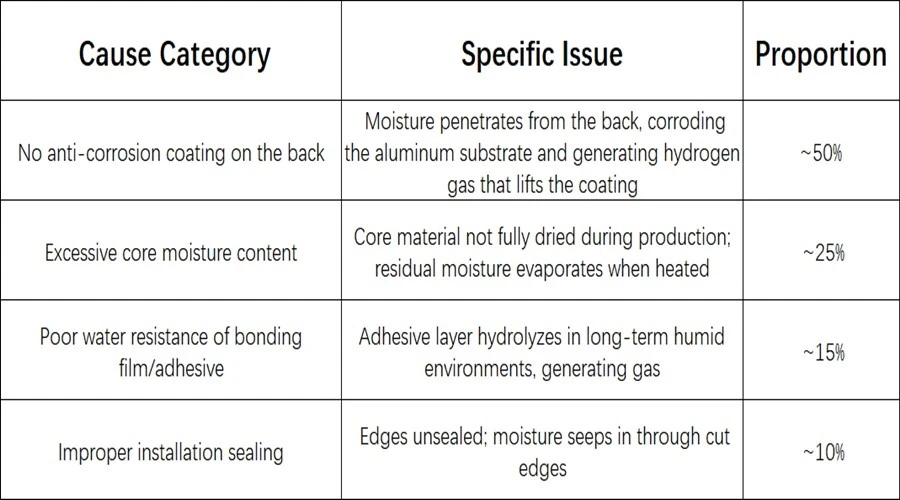
32 Years of Experience: Blistering is the "most unfair" issue for aluminum composite panels. No matter how beautiful the front coating is, if there is no anti-corrosion backing, moisture will attack from the rear and eventually push the front coating outward. Many low-cost suppliers cut corners precisely here.
Prevention Measures
- Procurement Stage: Ensure the panel has an anti-corrosion backing (usually primer + back coating; film thickness 5–10 μm).
- Core Moisture Content: Require suppliers to provide test data on core moisture content; the standard for compliance is usually ≤0.5%.
- Installation Sealing: Seal cut edges and areas around fixing points with silicone sealant to block moisture entry paths.
- Contractual Stipulations: Clearly specify the backing system and film thickness; reject products lacking a backing or failing to meet backing standards.

IV. Coating Fading: The Slowest Yet Costliest Quality Degradation

Symptoms
- Color gradually lightens, showing a marked difference when compared to the original sample.
- Surface chalking occurs (powder rubs off when touched).
- Glossiness decreases; the panel loses its original texture.
- Noticeable color variation between different batches or panels facing different directions.
Root Causes

32 Years of Experience: Fading is the slowest-developing quality issue, yet it carries the highest cost consequences. It typically becomes apparent only 3–5 years after installation, making accountability and replacement extremely difficult. Coating selection must always be based on the project environment and expected lifespan, rather than just the initial price.
Prevention
- Coating Selection:
- Long-term outdoor signage: HDPE (High-Durability Polyester) coating; 8–10 years of color retention.
- Coastal/extreme environments/landmark projects: PVDF (Fluorocarbon) coating; 15–20+ years.
- Indoor use: Standard PE is sufficient; no need for over-investment.
- Film Thickness: HDPE topcoat ≥18μm; PVDF topcoat ≥25μm. Clearly specify film thickness requirements in the contract.
- Coating Brand: Choose renowned brands like PPG, AkzoNobel, or Beckers; request weather resistance test reports.
- Color Consistency Control: Procure the full required quantity for a project at once, or require the supplier to provide a sealed reference sample panel for color matching against future batches.
V. Quick Diagnosis Chart: What is the issue with your aluminum composite panel?


VI. FAQ
Q1: Can delaminated aluminum composite panels (ACP) be repaired?
No. Delamination represents a permanent failure of the bonding interface; structural integrity cannot be restored through on-site repairs. Once detected, the entire panel must be replaced. This is why peel strength testing during the procurement phase is crucial.
Q2: Why did my ACP warp after installation, even though the supplier claims it is an installation issue?
Responsibility could lie with either party. First, check if adequate expansion joints were left during installation, and then verify if the core material is made from virgin resin. If both meet standards, investigate the thickness of the aluminum face sheet and the panel's flatness at the time of manufacture. Our 32 years of experience show that warping caused by insufficient installation gaps is more common than warping caused by the panel's inherent quality.
Q3: Which is more serious: blistering or fading?
Blistering is more serious. Blistering indicates a failure of the panel's anti-corrosion system and is a structural issue. Fading is an aesthetic issue; it affects appearance but not structural safety. Blistering requires immediate attention, whereas fading can be addressed later depending on project requirements.
Q4: How can I evaluate the quality of the supplier's coating?
Take three steps: ① Ask about the coating brand (well-known brands are a plus); ② Request a weathering test report (xenon-arc aging ≥ 3,000 hours); ③ Request physical samples for outdoor exposure observation or accelerated aging tests. If the product passes all three checks, the quality is generally reliable.
Q5: Do you provide quality inspection reports?
Yes. We provide reports covering peel strength, coating thickness, and color difference with our ACP shipments. For major projects, we can arrange for comprehensive testing by third-party agencies such as SGS or TÜV.
VII. 32 Years of Experience: The One Thing We Want to Tell You
Over the past 32 years, we have seen countless clients seek the root cause of a problem only after it has already occurred. Yet, 80% of these issues were destined to happen back at the procurement stage.
Whether an aluminum composite panel delaminates depends on the adhesive film and the supplier's lamination process you choose. Whether it blisters depends on the back coating and core material. Whether it fades depends on the coating type and paint film thickness.
These issues are not a matter of luck; they are a matter of choice.
When you buy aluminum composite panels, you aren't just purchasing a coil of aluminum, a layer of film, and a bucket of paint. You are buying the factory's attitude toward every single detail.
Do you need professional support for your aluminum composite panel project?
Send your project requirements (application scenario, coating specifications, aluminum thickness) to our email, and we will reply within 24 hours with a technical proposal that includes recommendations on key parameters, quality testing standards, and transparent pricing. We also offer free samples; you simply cover the shipping costs to verify the quality firsthand.
[Get Your Technical Proposal and Samples Now]

(This article was created by the HUABOND Aluminum Composite Panel team, drawing on 32 years of manufacturing and global project delivery experience. Authorization is required for reproduction. For more in-depth industry content, please visit our website at www.huaalu.com.)