

When choosing color-coated aluminum coils (pre-coated/color-coated) for a new project, have you ever experienced this dilemma: suppliers send you a bunch of grades (PE, HDPE, PVDF, FEVE) and thickness parameters, all seemingly similar, but with prices varying by a factor of two.
Choosing the cheaper option risks fading or bubbling in two or three years, leading to claims from the client; choosing the more expensive option risks exceeding the budget.
This is precisely the problem we aim to solve today. As a team with 32 years of experience in this industry, we won't show you lab reports; instead, we'll directly deliver the experience accumulated from hundreds of successful and failed projects worldwide.
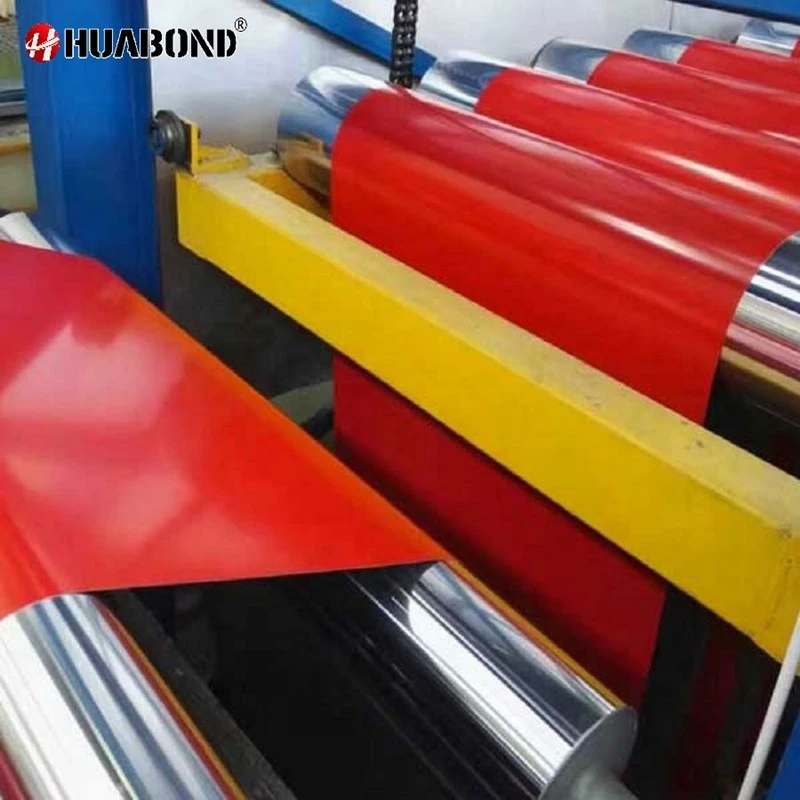
I. Don't focus on the color first; focus on the aluminum itself.
Coating problems sometimes stem not from the paint, but from the aluminum substrate. This is a lesson many beginners learn.
Alloy grade selection: For most architectural and decorative color-coated aluminum coils, AA3003 or AA3004 aluminum alloys are preferred. They have a moderate manganese content and good strength and formability. If you need bending or rolling, AA3003 is sufficient; if you need deeper stamping or riveting, AA3004 is better.
Our experience is that an Australian customer once purchased a batch of extremely cheap aluminum coils for roofing tiles, only to find cracks at the folds. Inspection revealed that the substrate used was the lower-strength AA1100. Although AA1100 has good corrosion resistance, its mechanical strength is simply insufficient for metal roofing systems requiring interlocking connections. Therefore, the first rule of thumb: for load-bearing components, choose AA3003 or AA3004.

Aluminum Coil Thickness Selection:
- 0.2mm-0.3mm: For indoor signage (aluminum signboards), nameplates, and one-time decorative applications only.
- 0.4mm-0.6mm: For interior ceilings, curtain wall panels (aluminum composite panels), curtain tracks, etc., within the cost-effective range.
- 0.7mm-1.0mm: The mainstream thickness for building exterior walls, roofs, awnings, and downpipes. This is our highest-volume specification in the European building materials market.
- 1.2mm and above: Special curtain wall details and high-end decorations.
Please note that when suppliers say "0.7mm thick," do they mean the thickness of the aluminum substrate or the total thickness including the coating? This is where price differences may lie; be sure to clarify this in the contract.
II. Coating Systems: A Trade-off Between Cost and Lifespan
In this section, we won't memorize parameters; we'll use scenarios to illustrate our points.
Scenario 1: I only do interior decorative wall panels, and my budget is very tight.
Answer: Ordinary polyester (PE) coating.
This is the lowest-cost option. Indoors, there's no UV radiation, and the gloss and color of the PE coating can last for over 15 years. However, never expose these panels to sunlight. Ordinary PE will noticeably fade after about 3 years of outdoor exposure. We supplied a batch of ordinary PE aluminum coils for interior partitions to a shopping mall project in South Africa. Ten years later, during renovations, the interior was still like new, but several panels mistakenly installed on the entrance awning at the same time powdered after only two years.
Scenario 2: I need to do factory exterior walls and warehouse roofs, requiring weather resistance but being cost-sensitive.
Answer: High-performance polyester (HDPE/Super Polyester) coating.
This is the real "profit zone." HDPE's UV resistance and anti-powdering capabilities far exceed those of ordinary PE, providing an 8-10 year color warranty in most non-extreme climates. Its price is about 40% lower than PVDF, making it the standard for industrial building envelope systems in North America and Australia. A word of advice: If you're bidding on a medium-sized industrial park project and your competitors are all using HDPE, using regular PE is a recipe for disaster; using PVDF will result in excessively high prices and lost contracts. HDPE strikes the perfect balance.
Scenario 3: My projects include seaside villas, high-rise landmarks, and airports, requiring no fading for over 20 years.
Answer: PVDF fluorocarbon paint (KYNAR® or equivalent).
This is the pinnacle of coating technology. PVDF coatings remain unmatched in weather resistance, chemical corrosion resistance, and chalking resistance. Under the scorching sun of Florida, the sandstorms of Dubai, and the corrosive sea salt of Southeast Asia, only PVDF can guarantee a presentable appearance after 20 years.
We once served a beachfront resort project in a Caribbean island nation where the owner specified PVDF aluminum coils for the curtain wall. Ordinary paint's lifespan would be halved under the humid heat and salt spray there. Saving money on this would be a disaster.
Scenario 4: I need ultra-high gloss, a mirror-like effect, and top-notch weather resistance.
Answer: FEVE fluorocarbon coating (LUMIFLON®).
FEVE is another powerful member of the fluorocarbon family, achieving over 80% high gloss and curing at room temperature. It is favored in high-end projects in Japan and Europe. When you want the durability of PVDF and the vibrant, high-gloss finish of automotive paint, FEVE is the only solution.
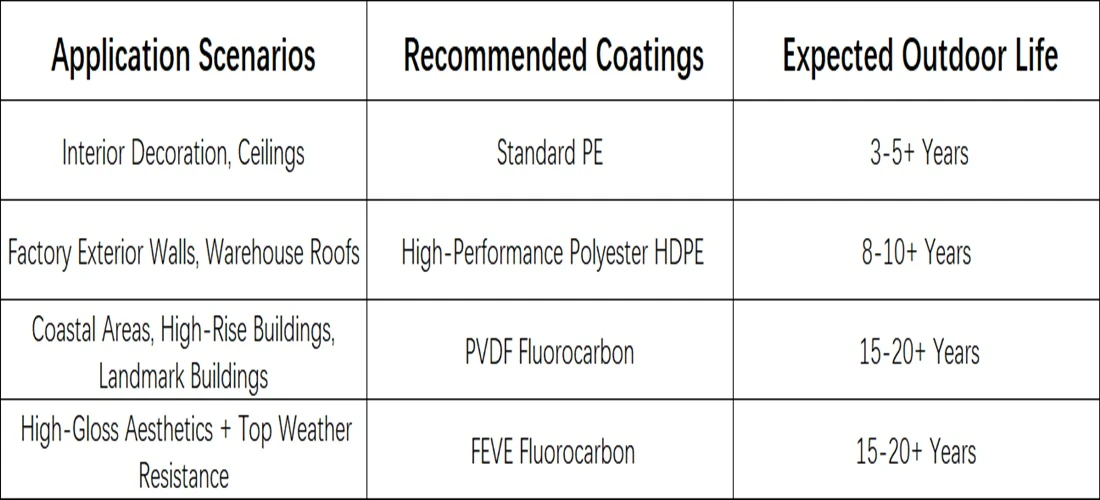
Quick Decision Table for Coating Selection:
III. Hidden Requirements No One Mentions
1. Film Thickness ≠ Weather Resistance
Thicker paint doesn't necessarily mean greater durability. The standard film thickness for PVDF coatings is 25-30μm, but even a 40μm coating on ordinary PE won't be as durable. Durability depends on the resin itself and the formulation. Therefore, asking "how many years of warranty" is far more direct than asking "how thick the paint is."
2. Don't Skimp on the Back Coating
Many customers think that as long as the front looks good, the cheapest back coating is fine. This is a big mistake. After the aluminum coil is formed, the back is also exposed to air, moisture, and condensation. We strongly recommend that for outdoor aluminum coils, the back coating should at least use a primer and a back coating of the same coating system. Otherwise, no matter how good the protective layer on the front is, moisture will corrode from the back, causing the coating to blister and peel.
3. Protective Film is the Last Line of Defense
Throughout transportation, uncoiling, bending, and installation, the protective film is an invisible safety measure. If you plan to use PVC film for deep drawing, please inform us in advance so we can provide a suitable protective film with appropriate stretch and no adhesive residue. A Dutch customer once experienced adhesive failure and marks due to using ordinary protective film for deep drawing, resulting in the scrapping of the entire batch of materials. We've helped you avoid this problem.

IV. Confirm these 5 points with the supplier before purchasing
This is a list we've distilled from countless orders; you can use it directly:
1. What is the aluminum alloy grade and actual thickness? (Is it AA3003 or something else? Is the thickness the base material or the total thickness?)
2. What brand and type of resin is the coating system? (PPG? Akzo? Valspar? Is it PE/HDPE/PVDF/FEVE?)
3. What is the thickness of the paint film on the front and the coating on the back? (Is there a back coating? What material is it?)
4. Do you have any special suggestions for my processing techniques (bending, stamping, lamination)? (Can you provide samples for testing?)
5. If it's for outdoor use, what is the warranty period for color and gloss? (The warranty covers chalking, cracking, fading, etc.)
Our approach is different: When you submit a project requirement to us, we don't respond with a quotation, but with a technical confirmation sheet containing all the details mentioned above. Because we've understood for the past decade that choosing the wrong coating can cost a client more than just an order; it can cost them the reputation of an entire market.
[Send project drawings or a description of your requirements],and let us leverage our over thirty years of global project experience to find you a precise coating solution without inflating costs.